Seongdae 성대
Relic
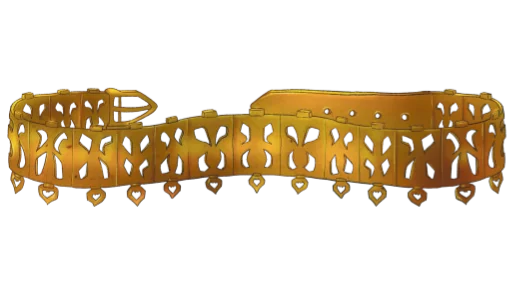
Sacred Belt
Seongdae (성대), literally the Sacred Belt, is counted among Silla’s celebrated Three Treasures. More than a mere list of valuables, these treasures were symbols of divine legitimacy and national protection. Chronicles say they were so revered that even a Koryo king, once intent on conquering Silla, abandoned his plans when he learned the kingdom was shielded by them.
Together the Three Treasures form a cohesive, power-laden triad:
• The Sacred Belt, Seongdae: the emblem of heaven-granted kingship. Delivered to the throne by a messenger from the skies, it is the physical proof that the monarch’s authority comes from above.
• The Nine-story Pagoda of Hwangnyong-sa: the banner of political ambition and military might. Commissioned by Queen Seondeok, the pagoda’s nine tiers stood for the nine realms and tribes Silla sought to subdue.
• The Jangnyuk Samjon Buddha of Hwangnyong-sa: the vessel of religious and spiritual authority. Cast with gold and iron said to have been sent by the legendary Indian king Aśoka, the statue showed Silla to be the true Buddhist nation, blessed by the Buddha himself.
According to Samguk Yusa, Seongdae was not man-made. In the year King Jinpyeong (r. 579–632) ascended the throne, a heavenly envoy sent by the Lord of Heaven appeared, handed him the belt, and vanished. The gift became the keystone of the king’s claim to a divine mandate, reinforcing that his rule was sanctioned not merely by inheritance but by the heavens.
Descriptions say the belt was fashioned from two precious materials— gold and jade—“a golden band adorned with jade.” It held sixty-two jade plates set onto a gold base, each plate said to bear an engraved fragment of a celestial secret.
The choice of materials is deeply symbolic in Korean thought. Gold represents supreme authority and divine sanction, reserved for the loftiest rites; jade embodies purity, immortality, and a direct link to the heavenly realm, associated with virtue and righteousness.
Seongdae’s chief mystical trait is invisibility. To ordinary eyes it cannot be seen, nor detected by mundane means. This is no passive defense; it is an active test of legitimacy. The belt reveals itself only after a seeker—traditionally the king—proves sincerity and reverence through the proper ritual.
From Korean Bestiary 5E, p. 107 · Fern Flower Press