Jeung 제웅
Relic
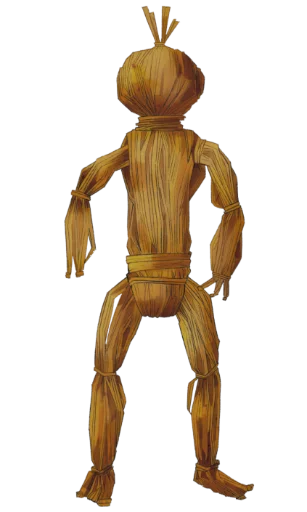
Straw Effigy
Jeung (제웅) – usually called a “straw doll” in English – is one of the most multifaceted objects in Korean folklore. Far from being a simple toy, it is a temporary vessel used in folk-magic rites. Its power lies in its built-in duality: handled one way, it becomes a protective charm that diverts misfortune; handled another, it turns into a conduit for a curse.
On the first full-moon festival of the lunar year, villagers once practiced a rite known as “Throwing Out Jeung.” In that ceremony the doll served as a scapegoat, absorbing a household’s sicknesses and bad luck before it was destroyed. Children played a key role: they roamed from house to house asking for the dolls, then smashed them open to get at the coins hidden inside. The game, called tachhuhi, turned a solemn act of purification into a community frolic, and the shattered doll signaled that the misfortune had been broken up and carried away.
How the Ritual Worked
1. A family made a straw doll and dressed it in the cast-off clothes of the person they wanted to protect.
2. They wrote that person’s name or birth characters on the body, and tucked coins into the head to “bait” the bad luck.
3. When the ritual ended, they dumped the doll at a crossroads or bridge—liminal places where different worlds and energies intersect and where negativity can be off-loaded.
4. Village kids later found the doll, tore it apart, and pocketed the coins, symbolically finishing the cleansing job.
Jeung is small—about 8–12 inches (20–30 cm) tall—but often finely made, complete with separate straw fingers and toes. Straw itself is loaded with meaning: it stands for life, harvest, and fertility, yet also for fragility and impermanence.
Jeung works through sympathetic magic. It looks like a person (the law of similarity) and is linked to that person by clothing and inscriptions (the law of contact). Fused together, the two laws create a powerful proxy: the doll doesn’t just resemble its human target, it becomes the target in the magical sense. As a “decoy,” it intercepts any spell or ill will aimed at the real person; if charged with malice, it can also bounce that harm back at them.
In short, Jeung is both shield and weapon—proof that in Korean folk belief the line between protection and peril can be as thin as a stalk of straw.
From Korean Bestiary 5E, p. 105 · Fern Flower Press