Heukokdae 흑옥대
Relic
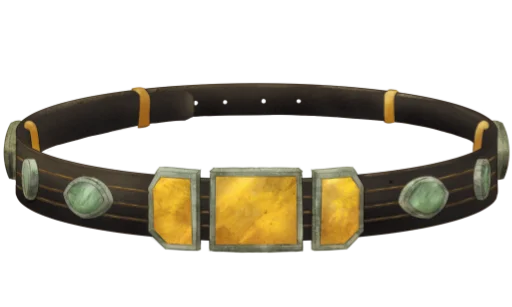
Black Jade Belt
Heugokdae (흑옥대)—usually rendered in English as the “Black Jade Belt”—is one of the most striking and mysterious objects in Korean legend. Tied to the reign of King Sinmun of Silla, the belt isn’t just court regalia; it is the tangible proof of a ruler’s divine mandate and a reservoir of supernatural power.
According to the tale, the Black Jade Belt is made of dark-green jade plaques linked together. Each plaque bears an engraved dragon—and the engravings aren’t merely decorative. Every plate is said to imprison a living dragon bound inside the stone.
Early in his reign King Sinmun had to put down a rebellion led by his father-in-law, Kim Heumdol. In Korean lore dragons stand for raw, unpredictable power. By “locking” them into the belt, Sinmun shows he can tame even the most chaotic forces—just as he subdued a restless aristocracy. The belt, then, is less an accessory than a container filled with conquered might. Heugokdae is not an offensive weapon. Its purpose is divine protection: when the wearer is in mortal danger, a plaque can be unleashed, releasing the dragon inside to defend its master. The defense is active, dramatic, and unmistakable.
Legend of Yongyeon Pond
A famous episode centers on the crown prince, the future King Hyoso. Playing beside a stream, he tosses one jade plaque into the water. Instantly it transforms into a dragon that rockets skyward, and a pond—Yongyeon, “Dragon Spring”—forms where it landed. The story drives home two points: 1) each plaque is a living dragon, and 2) once released, it’s gone for good. Every “charge” leaves an irreparable mark on the world—in this case, a brand-new body of water.
In short, the Black Jade Belt is both symbol and safeguard: a portable treasury of chained dragons that proclaims a king’s absolute authority and springs to life when that authority is threatened.
From Korean Bestiary 5E, p. 104 · Fern Flower Press